Most people with serious gum disease have already heard the bad news once. They were told their bone was too damaged, their situation too far gone, and implants were not an option.
Patients across India are discovering that the timeline everyone assumed is not the only one available.
Why Traditional Implants Fail Periodontitis Patients — And What Changes With Immediate Rehabilitation for Periodontitis Cases
Periodontitis — serious gum disease — destroys the bone that traditional implants need to survive. This is the clinical reality that leads so many dentists to turn patients away.
Traditional implants rely on cancellous bone — the softer inner layer of the jaw — to bond with over months. Periodontitis deteriorates exactly this bone layer. Without it, conventional treatment either fails or requires extensive bone grafting before anything else can be done.
Immediate loading implants take a completely different route. They anchor into cortical bone — the dense outer layer that sits below the cancellous layer. Cortical bone is stable. It does not resorb (shrink away) over time. That is why this same bone type has been used in traumatology for decades to stabilise fractures. It is always available, regardless of how much bone loss periodontitis has caused above it.
The 72-Hour Timeline — What Actually Happens Step by Step
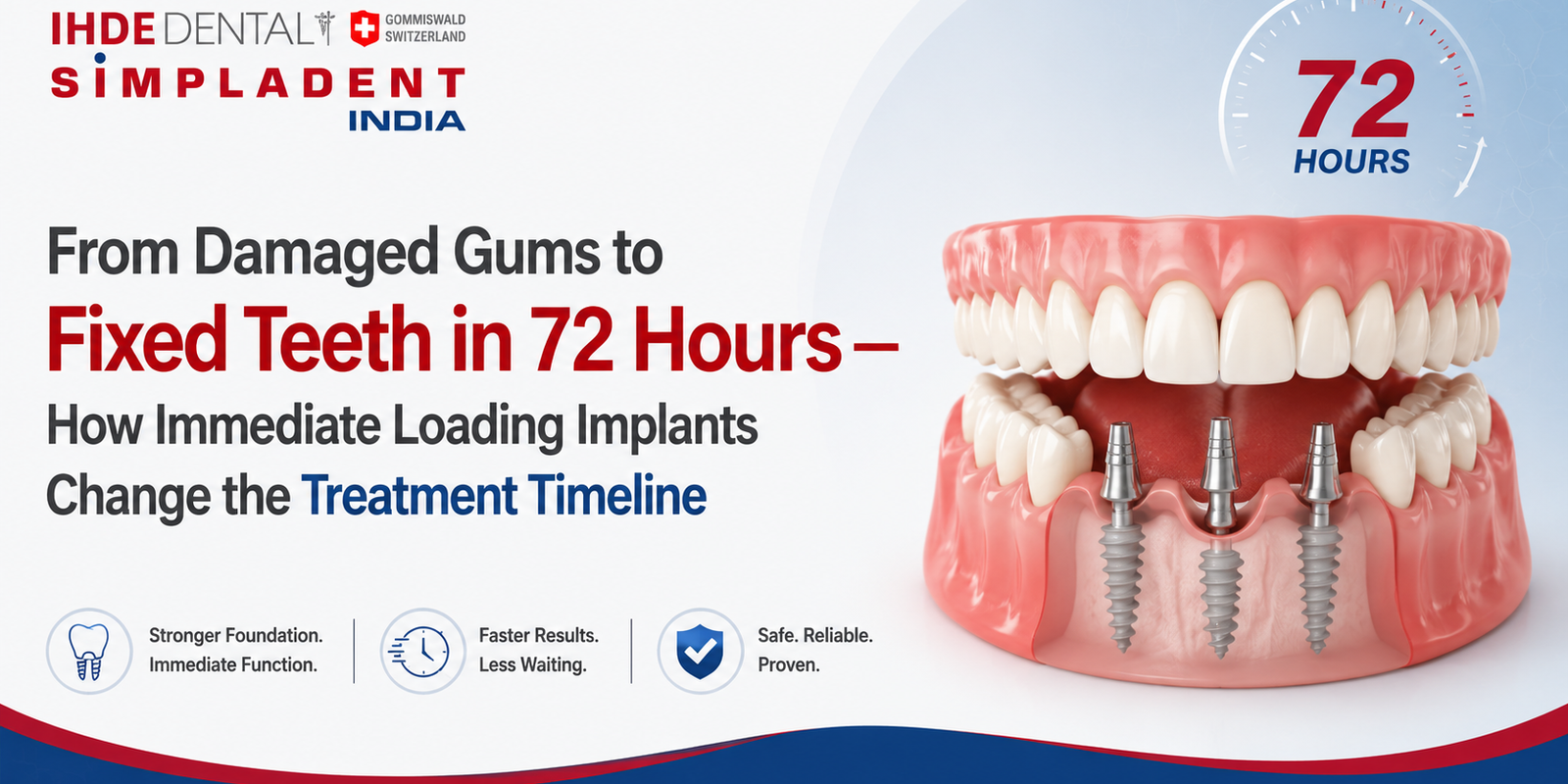
Simpladent India specialises in taking patients from no functioning teeth to fixed teeth within 72 hours. This is not an approximation. It is a structured clinical process.
It begins with a thorough assessment and personalised treatment planning. Every patient’s situation is different — the extent of periodontal involvement, the bone available, the jaw structure. Simpladent’s team evaluates each case individually and creates a specific plan before any procedure begins.
Once the plan is confirmed, implants are placed using Strategic® Implantology — advanced techniques that allow placement even in cases of severe bone loss. Even in periodontitis cases with significant bone deterioration, the cortical bone provides the stable anchor needed.
Most people don’t realise that the infection site itself does not prevent implant placement. The treatment removes affected tissue at the time of implant surgery, meaning the infected environment is addressed as part of the same appointment rather than as a separate pre-treatment stage.
A patient with advanced periodontitis visited Simpladent after being refused treatment at two other clinics. Within three days, they had fixed teeth. Within weeks, they were eating normally. That is what immediate rehabilitation for periodontitis cases actually looks like in practice.
What Happens After the Bridge Is Delivered — Why Ongoing Care Matters
Simpladent’s approach does not end when the bridge is placed. Post-treatment care and ongoing monitoring are built into the process to ensure long-term success of the implants and overall oral health.
This matters particularly for periodontitis patients — whose gum health needs active management even after implants are in place. Regular check-ups protect the result. They catch early signs of any stress on the implants and allow adjustments before small issues become larger ones.
The Dental Implant Training India programme at Simpladent ensures that treating dentists are not generalists applying conventional knowledge to a specialised method. The team is trained specifically under Prof. Dr. Stefan Ihde, a pioneer in implantology, to handle exactly the kind of challenging periodontitis cases that other clinics decline.
That specialised training is what backs the 98.2% success rate reported for Strategic Implant procedures.
Why India’s Most Challenging Implant Cases Come to Simpladent
Here is the honest summary of what makes Simpladent the right choice for patients who have already been told no.
Immediate loading. No bone grafting. No sinus lift procedures. A team trained under international standards by Prof. Dr. Stefan Ihde and the International Implant Foundation. A scientifically backed approach with a documented success rate. Post-treatment monitoring built into every case plan.
The clinic is at 4th Floor, KM Trade Tower, near Radisson Blu, Kaushambi, Ghaziabad —accessible from across Delhi NCR and beyond. Dental tourism support is available for patients travelling from outside the region. The team is reachable at +91 9711150803 , info@simpladent.in or via the Simpladent India app.
When you are ready to understand what immediate loading implants could mean for your specific situation — particularly after periodontitis — the first step is a consultation with Simpladent India. Immediate rehabilitation for periodontitis cases is not a last resort. It is a structured, proven process that begins with one honest conversation about your dental goals.
Keep yourself updated following our Social Page for the latest news and information.