A doctor told you that you smoke, so implants won’t work for you. Or your bone is too thin. Or you have a health condition that rules it out. Here is what a peer-reviewed consensus document by the International Implant Foundation actually says about that.
Basal Implants India — Why the Rules Are Completely Different
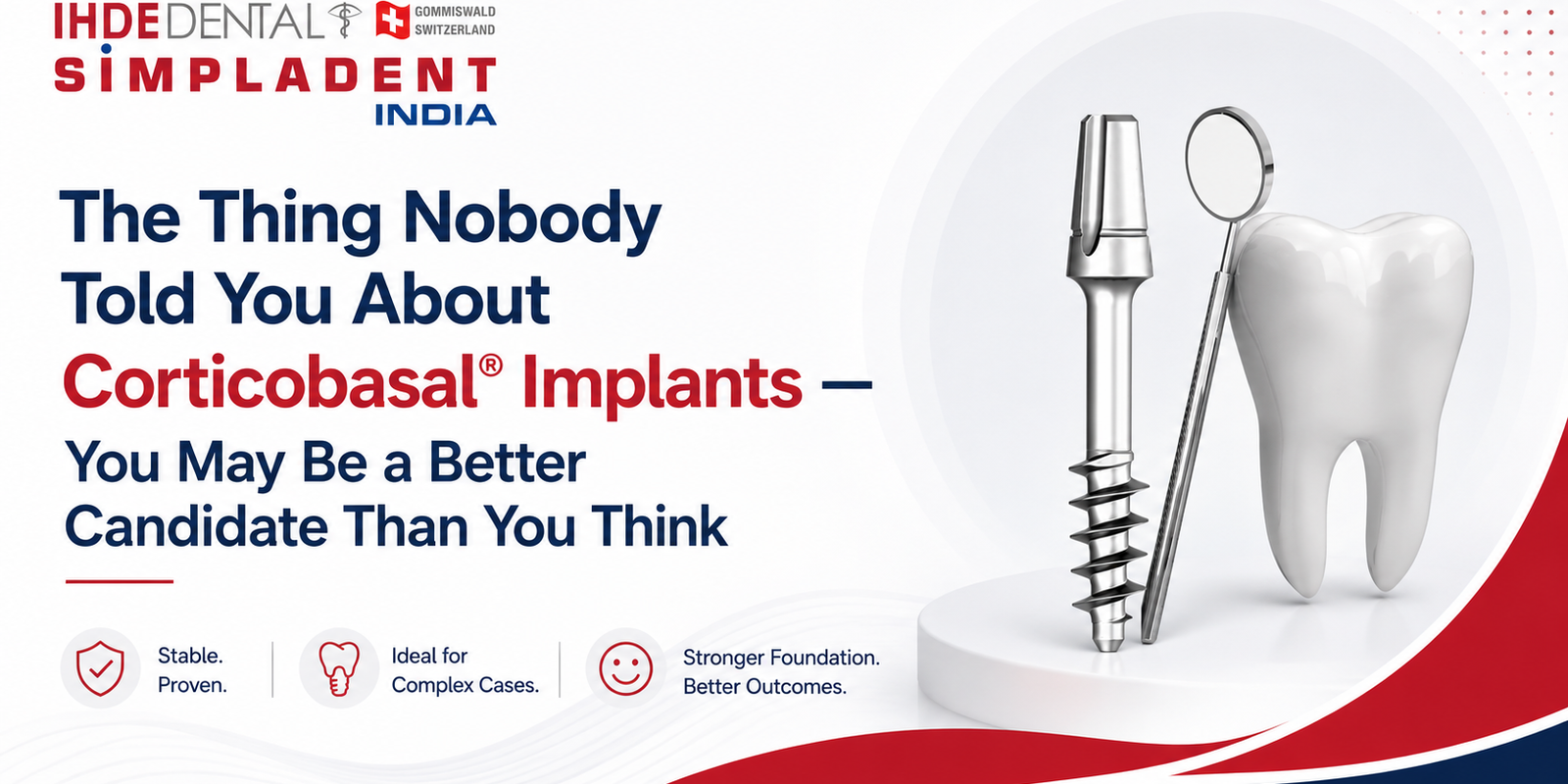
Corticobasal® Implants work on a completely different principle than conventional dental implants. This is not a subtle difference — it is fundamental.
Conventional implants need months to bond with the soft, cancellous bone layer of the jaw. The technical term is “osseointegration.” During those months, you cannot load the implant, which is why traditional implant treatment takes so long.
Corticobasal® implants skip that waiting entirely. They anchor immediately into the cortical bone — the dense, hard outer layer of the jaw. The anchoring method is borrowed from traumatology (fracture repair surgery) and orthopedic surgery. It is the same principle used to fix broken bones with plates and screws. The bone doesn’t need to “bond” — it just needs to be stable enough to hold the anchor.
This means the rules that apply to conventional implants — including many of their contraindications — simply do not apply to basal implants.
Smokers, Thin Bone, Complex Health: What the Research Actually Says
The consensus document is direct: smoking by itself is not a contraindication for Strategic Implant® (corticobasal® ) therapy.
Smokers who have been turned away by conventional implant clinics are often turned away because bone grafting fails more often in smokers. Basal implants in India require no bone grafting at all. The paper notes that heavy smokers typically have very clean sinuses — which actually makes them well-suited for certain corticobasal® approaches.
Most people don’t realise that the same patients who are rejected by conventional implant clinics are often the ideal candidates for corticobasal® treatment.
For patients with controlled medical conditions — diabetes, hypertension, managed periodontal disease — the consensus document confirms that many conditions do not affect
the implant’s success directly. What may need review is any medication that affects bone physiology. A consultation with your physician and the implant team is all that is typically required.
The one condition that IS a true contraindication is intravenous bisphosphonate therapy — a drug sometimes prescribed for osteoporosis. Oral bisphosphonates are handled differently on a case-by-case basis.
Less Invasive Than Removing a Tooth — A Fact That Changes Everything
Here is the insight that stops most nervous patients mid-sentence: placing a corticobasal® implant in a flapless procedure — meaning without cutting open the gum — is less invasive than a standard tooth extraction.
That is not a patient comfort claim. It is a clinical conclusion drawn directly from the consensus document.
The polished surface of a basal implant means bacteria cannot colonise it the way they can on the rough surface of a conventional implant. This is why peri-implantitis — the painful infection that destroys conventional implants — does not occur around corticobasal® implants according to the document.
The document also notes that treatment can be carried out in any standard dental office where a tooth can be safely extracted. Minimal additional equipment is required.
Why Simpladent Follows the Highest International Standards for Basal Implant Placement
Corticobasal® implants require specific training. The consensus document is clear: experience with conventional implants does not qualify a dentist to place corticobasal® implants. The two systems operate on entirely different principles.
Simpladent India’s dentists train under the framework developed by the International Implant Foundation, Munich, Germany — the same body that authored this consensus document. Simpladent follows the 16 recognised methods for placement of corticobasal® implants, as published and updated by the International Implant Foundation over more than 20 years.
The consensus document was first published in 1999 and has been reviewed and updated multiple times. India is one of the countries where this technology is actively delivered at the international standard.
Patients across India — including in Ghaziabad and the wider Delhi NCR — have access to this treatment at Simpladent’s clinic at 4th Floor, KM Trade Tower, near Radisson Blu, Kaushambi. Free consultations are available by calling +91 9711150803 or via the Simpladent India app.
When you are ready to find out whether corticobasal® implants are the right path for your situation, the first step is a conversation — not a commitment. Simpladent offers free consultations where the team reviews your specific case and explains exactly what is possible. Basal implants India treatment has already helped patients who had been told implants were closed to them. Your case may be simpler than you think.
Keep yourself updated following our Social Page for the latest news and information.